The rim joist is the band of framing that caps your foundation, and in Northwest Arkansas it moonlights as the entrance for October lady beetles, summer humidity, and winter floor drafts. Two to three inches of closed-cell retires it from all three jobs in an afternoon.
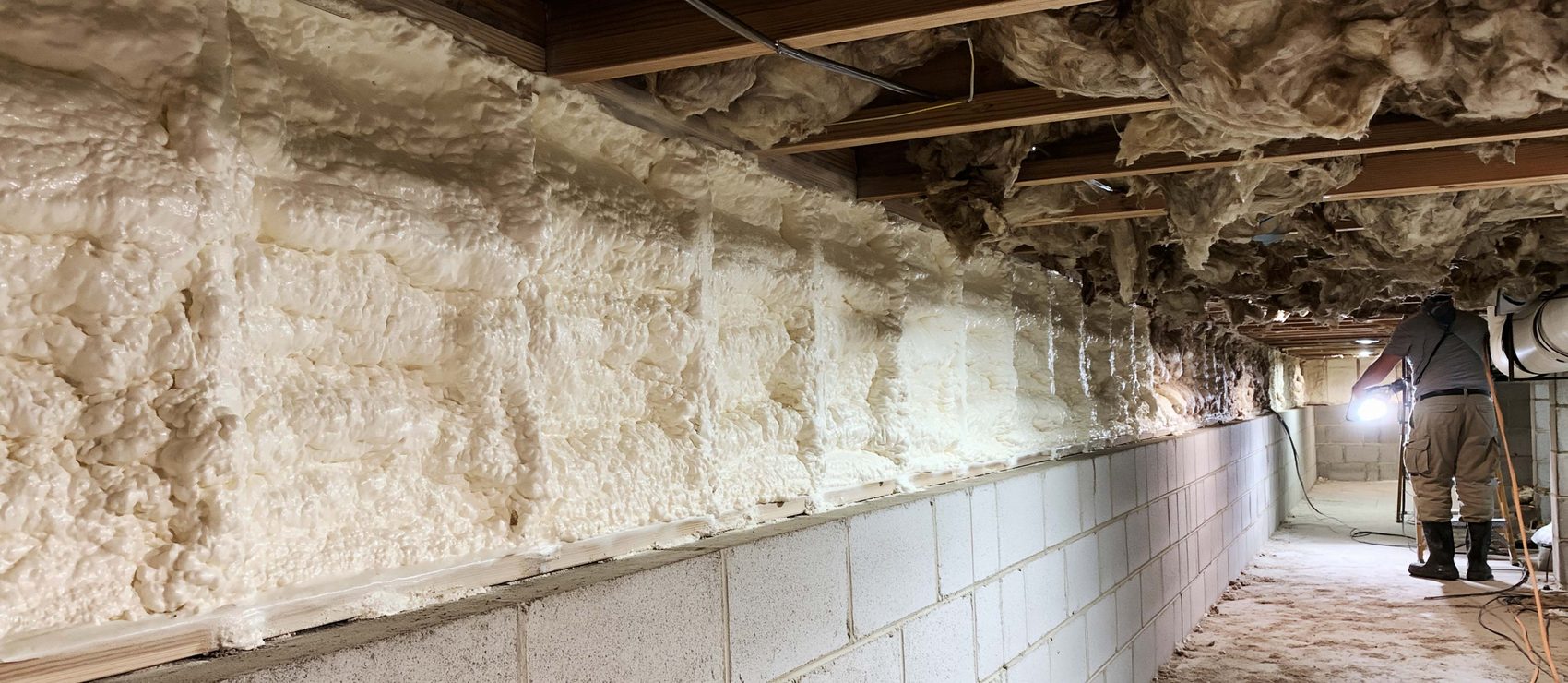
Fayetteville AR Spray Foam can walk up to almost any house in Washington County and point at the problem from the driveway: the band of framing sitting on top of the foundation, wrapping the entire footprint, insulated by nobody since the day the floor was framed. Rim joist insulation is the quickest project on our list and the one homeowners have most often never heard of, which is a strange fate for the piece of the house that separates your crawl space from your living room. Framers call it the band joist. Everything else calls it the way in.
Everything uses this doorway. Air uses it first: winter wind works through the gaps where the rim meets the sill and the subfloor, and those drafts skate across your floors all season. The trades used it too, because every hose bib, condenser line, dryer vent, and cable run that ever entered the house was drilled through this band, and almost none of those holes were sealed to last. And every Arkansas fall, the pests confirm it, when the lady beetles massing on the sunny side of the house start showing up inside instead. They are not coming through the front door. They are coming through the twelve inches nobody looks at.
Foam does what batts up there cannot. The fiberglass chunks you may find stuffed in those bays are air-permeable, which means they filter the incoming air rather than stop it, and their loose fit makes the bays a favorite winter address for mice and wasps. Closed-cell foam works differently: it bonds to the wood and the block, floods around every pipe and wire penetration, and cures into a rigid air and vapor seal across each bay, reaching R-12 to R-20 territory at two to three inches. The band goes from the leakiest framing in the house to the tightest in a single pass, and unlike a batt, there is nothing to sag, slump, or nest in afterward.
It is the rare project that is small, fast, permanent, and felt the first cold morning after.
As a standalone visit, rim joist insulation is one of the least expensive projects a foam rig ever parks for, priced in hundreds rather than thousands for most homes and finished before dinner. It also happens to be the natural companion to crawl space encapsulation, since the crew, the equipment, and the access hatch are already in play, which drops the added cost of the rim work to its minimum. Plenty of homeowners start with the rim alone, feel the difference at floor level, and book the crawl space the following season. Either order works. The house just wants the doorway closed.
As its own project, most homes land in the $1,500 to $2,800 range depending on the footprint of the house, access to the bays, and how many utility penetrations need sealing along the way. Booked alongside a crawl space encapsulation, the added cost drops well below the standalone number because the crew and rig are already on site. Either way it consistently ranks among the least expensive things we do and among the most noticeable per dollar, and the exact figure comes from counting your actual bays at the estimate.
Stand in the crawl space and look at where the wooden floor structure lands on the foundation: the vertical board running around that entire perimeter, capping the ends of the floor joists, is the rim joist. It is above the concrete and below the walls, which puts it outside the reach of both the foundation and the wall insulation, and in most houses it was never insulated by anyone at any point. Every house with a raised floor has one, and it wraps the full footprint of the building.
Because fiberglass slows air down without stopping it, and stopping it is the entire job at the rim. A batt pressed into a joist bay lets outdoor air seep through and around it all winter, collects dust as evidence, and offers mice and wasps exactly the soft, hidden bedding they are looking for. Foam closes the bay instead of furnishing it: bonded to the wood, sealed around the penetrations, and solid enough that there is nothing to tunnel into or pull loose.
It closes one of the biggest entrances, and it is honest to say it is not the only one. The lady beetles, box elder bugs, and wasps that gather on the warm side of Arkansas houses every October get in through the rim band, gaps at the soffits, and openings around windows and vents, so foaming the rim typically produces a dramatic reduction rather than a perfect zero. We seal every penetration we can reach while we are in the bays, and we will point out the other entry points we notice so you can close the loop.
Most rim joist projects are a single afternoon, and because the work happens in the crawl space or basement level rather than the living space, staying home is usually workable. We ventilate the work zone during and after the spray, keep the area itself off limits until the foam has cured, and confirm the specific re-entry guidance for the product we are using before the visit so you can plan the day without guessing.
Yes, and it is a completely legitimate standalone project. A sealed rim over a vented crawl space still stops the floor drafts, the pest entries, and the leakage at the top of the foundation wall; it simply leaves the crawl space itself as a future project rather than a finished one. If encapsulation is on your someday list, doing the rim first loses nothing, since the same foam becomes part of the full system whenever the rest of it gets built.
The rooms around the perimeter of the house notice it first, because the cold air that used to spill in at the band and slide across the subfloor stops arriving. If the whole floor runs cold rather than just the edges, the cause usually lives below it, in a vented crawl space that keeps the entire underside of the house at outdoor temperature, and we will tell you plainly which situation your house has when we are in the bays looking at it.
Tell us whether the bugs, the drafts, or the bills sent you here. We will check every bay around the footprint and put a number on it before we leave the driveway.
