The attic is where both halves of the Arkansas year show up first. Sealing it at the attic plane or the roof deck settles the whole house down, from the power bill to the bedroom over the garage.
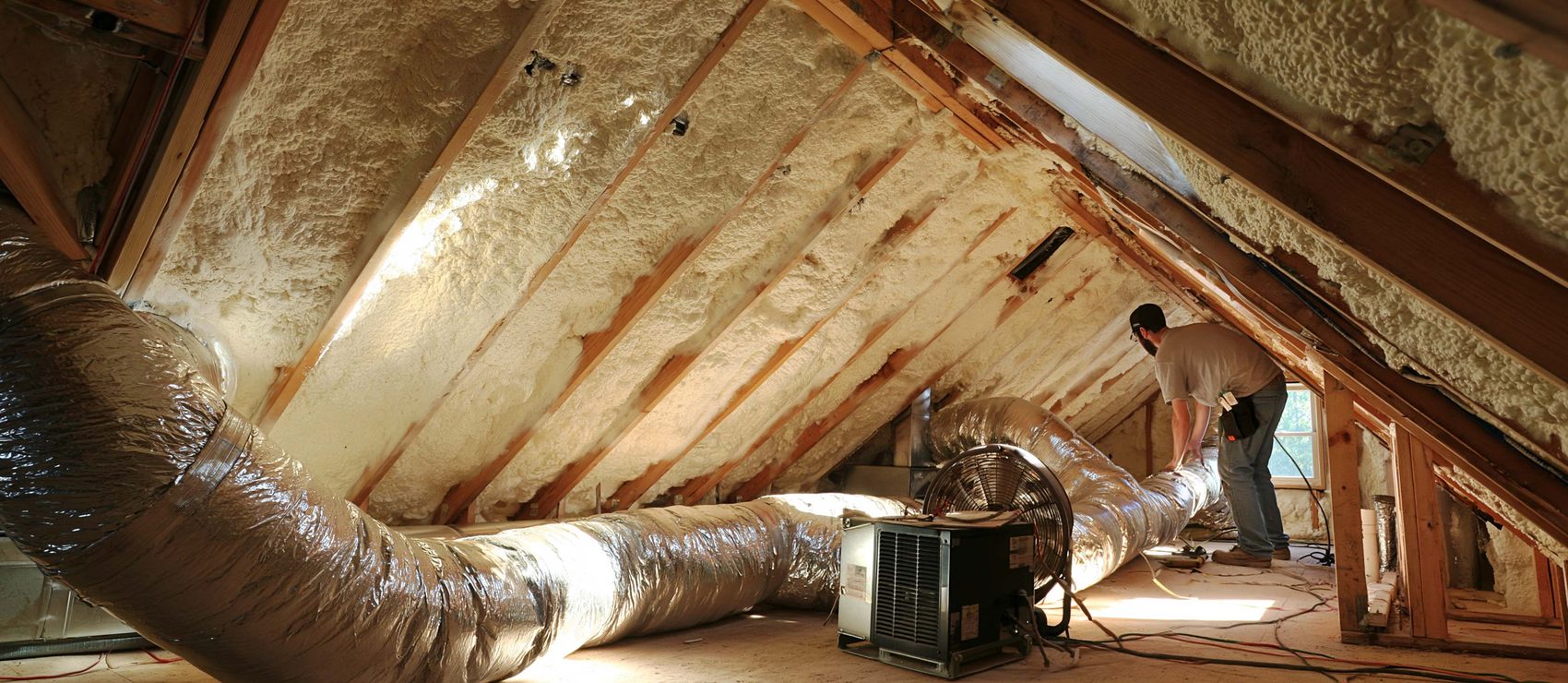
Fayetteville AR Spray Foam sees the same attic twice: once in February, when it quietly lets the furnace heat go, and again in August, when it presses the morning's sun down into the bedrooms. No other part of an NWA house switches sides with the calendar like that, which is why attic spray foam insulation is the most requested line on our board. The attic insulation already up there in most local homes is a thin gray layer doing about half its rated job, settled below the joist tops and never air-sealed underneath.
January asks the attic to hold on. Warm air finds every gap in the ceiling plane, the hatch, the top plates, the can lights, and carries your heating dollars into the eaves. When an ice storm takes the power down, that same leakage decides whether the house stays livable for hours or goes cold in one. A sealed attic holds the heat you already have, on the grid or off it.
July asks the attic to let go. An Ozark attic can run 40 degrees or more above the afternoon outside, and every ceiling gap that leaked heat upward in winter now feeds that load downward. The air conditioner spends its evening paying the attic's bill instead of cooling the rooms you live in.
Foam at the attic plane or the roof deck settles both accounts at once:
Whether the foam belongs on the attic floor or the underside of the roof deck depends on your roofline, your equipment, and your plans for the space, and it is the first call we make at the walkthrough.
Every shower, pot of pasta, and load of laundry adds water vapor to the air in your house, and in winter that vapor rides warm air up through the ceiling gaps into a cold attic. It condenses on the underside of the roof decking, frosts the nail points, and then lets go during the next thaw, which is where those mystery ceiling stains that appear every March come from. Sealing the ceiling plane with foam stops the ride at the source, so household moisture stays down where the HVAC can manage it instead of collecting on cold wood overhead. In a mixed-humid climate, the air seal is doing quiet moisture work all winter long.
It depends on which assembly we are building. Foam and air sealing at the attic floor of a typical NWA home usually runs $2,000 to $6,000, while a full roof-deck application in open-cell that brings the attic inside the envelope generally lands between $4,000 and $9,000, with attic size, foam depth, and any old insulation removal driving the spread. Roof-deck projects cost more and do more, since they protect ductwork and open the attic up as usable space. We price both options at the same walkthrough so you can compare real numbers instead of averages.
Both are legitimate assemblies, and the house tells us which one it wants. Foaming the attic floor keeps the attic outside the conditioned space and costs less, which suits simple rooflines used for nothing but storage. Foaming the roof deck creates a sealed, semi-conditioned attic, which is the right call when HVAC equipment or ducts live up there, when the space is finished or might be, or when complicated framing makes a clean floor-plane seal impractical. The choice is the first decision of the estimate, and we will show you the reasoning either way.
The code target for ceilings in our climate zone is R-49 under the commonly referenced IECC editions, though the exact requirement depends on which edition your jurisdiction has adopted and the compliance path your project uses. What matters in practice is that most existing NWA attics measure far below any modern target, and foam reaches high R-values in much less depth than loose fill while sealing air leaks the fill was never going to touch. We measure what is up there and spec to the standard that applies to your project.
This worry comes up often and the research is reassuring. Studies of unvented foam roof assemblies have measured shingle temperatures only a few degrees warmer than identical vented roofs, a smaller difference than the color of the shingle makes. What actually shortens shingle life in Arkansas is hail, UV exposure, and age. Major shingle manufacturers offer warranty paths for unvented assemblies, and we can walk you through the documentation for your roof before any foam goes on.
In most cases that frost is the symptom this page exists for. Warm indoor air is leaking up through the ceiling plane, carrying household moisture onto cold roof decking where it freezes, then dripping when the weather turns. Sealing the ceiling plane, or foaming the roof deck so the sheathing never gets cold enough to condense on, shuts the mechanism down. If the moisture is coming from a roof leak or a bathroom fan venting into the attic instead of outside, we will spot that during the inspection and tell you plainly, because foam is not the fix for a plumbing or venting problem.
For a floor-plane job, yes, the storage has to come out of the work area so we can reach the entire ceiling plane, and we will tell you exactly which zones matter at the estimate. For a roof-deck job we need clear access to the rafter bays, which usually means moving boxes toward the center rather than emptying the space. Either way, plan for the attic to be off limits during the spray and the cure window, and we will confirm the re-entry timing for the product we use before work starts.
Open-cell is the usual pick for Arkansas roof decks: it fills deep rafter bays economically, dampens rain noise, and stays vapor-open so the assembly can dry inward, which is the drying direction a mixed-humid climate wants. Closed-cell earns its place on roof decks with limited depth, on metal roofing, or where a project calls for maximum R-value per inch. Plenty of attics get both, closed-cell where the geometry is tight and open-cell through the big bays, and the spec follows the framing rather than a one-size answer.

Tell us what the upstairs feels like in August, or what the bills did last winter. We will get up there, measure what exists, and price both ways to foam it.
